science & techESA/Hubble
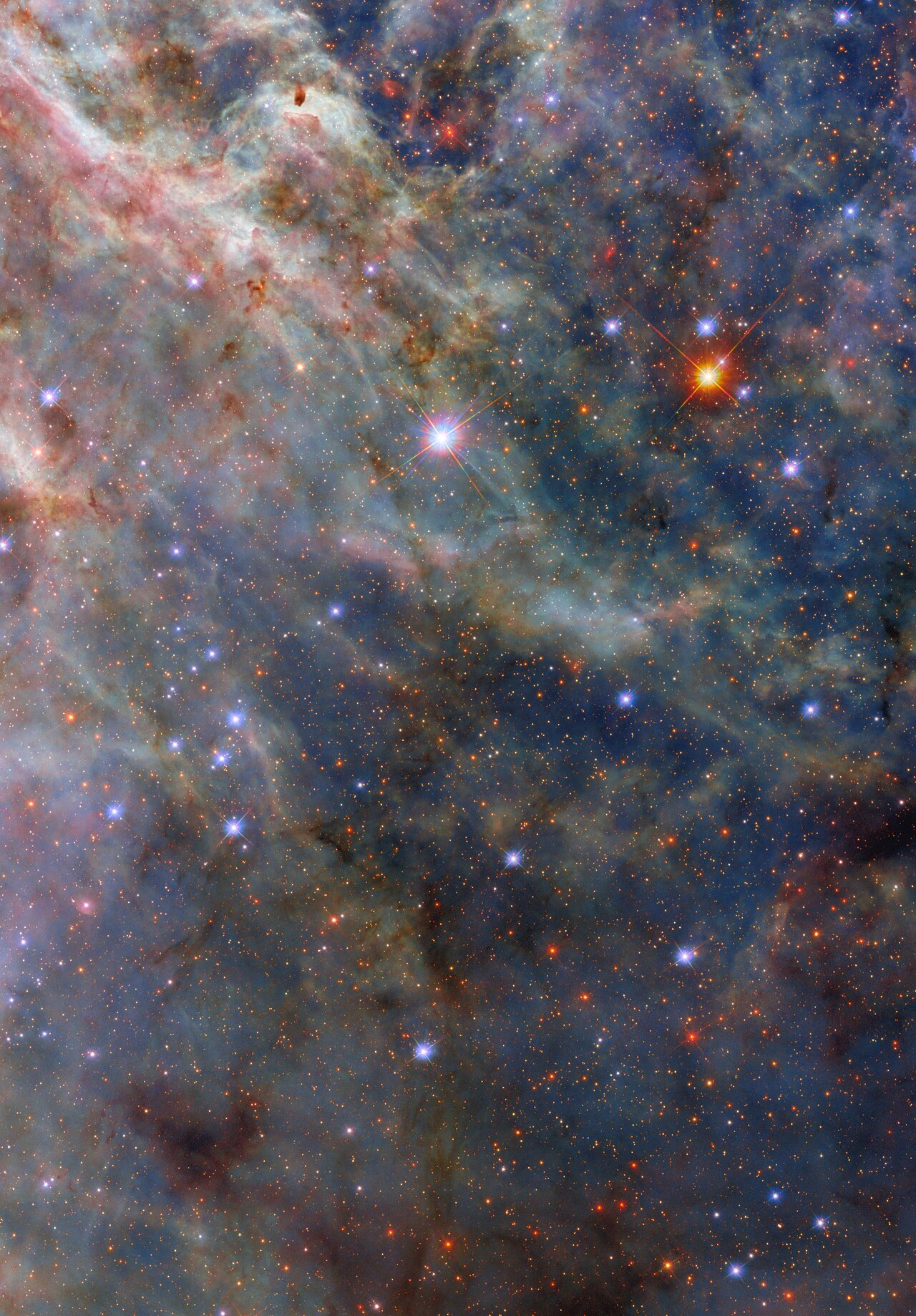
A Hubble view of the Tarantula Nebula, home to some of the most massive stars known
The Tarantula Nebula is a huge star-forming region in the Large Magellanic Cloud, a small galaxy about 160,000 light-years away that orbits the Milky Way. It is the largest and brightest star-forming region in the whole group of nearby galaxies, and it holds some of the most massive stars known, roughly 200 times the mass of the Sun. This image shows dusty clouds near a Wolf-Rayet star, a rare kind of massive star that has lost its outer hydrogen layer and is extremely hot and luminous. Such stars drive furious stellar winds that sculpt the surrounding gas and dust into the shapes seen here. The observations come from a programme called Scylla, which studies the gas and dust around young massive stars and complements the ULLYSSES programme that studies the stars themselves.
Massive stars burn fuel very fast and die young, and their intense radiation and stellar winds push and heat the gas around them. Wolf-Rayet stars lose their hydrogen envelopes to powerful winds, exposing hotter layers that glow intensely. Hubble's ultraviolet and infrared views reveal dust and gas structures that visible light alone would hide.
The Tarantula Nebula is a close laboratory for how the most massive stars form and die in a environment with fewer heavy elements than the Milky Way, which resembles conditions in the early universe. Studying it helps astronomers test models of star formation and the feedback that shapes galaxies.
The Large Magellanic Cloud is visible to the naked eye from the Southern Hemisphere as a faint cloudy patch.

