science & techESO
Three gas clouds orbiting the Milky Way's black hole may all be spat out by one pair of stars
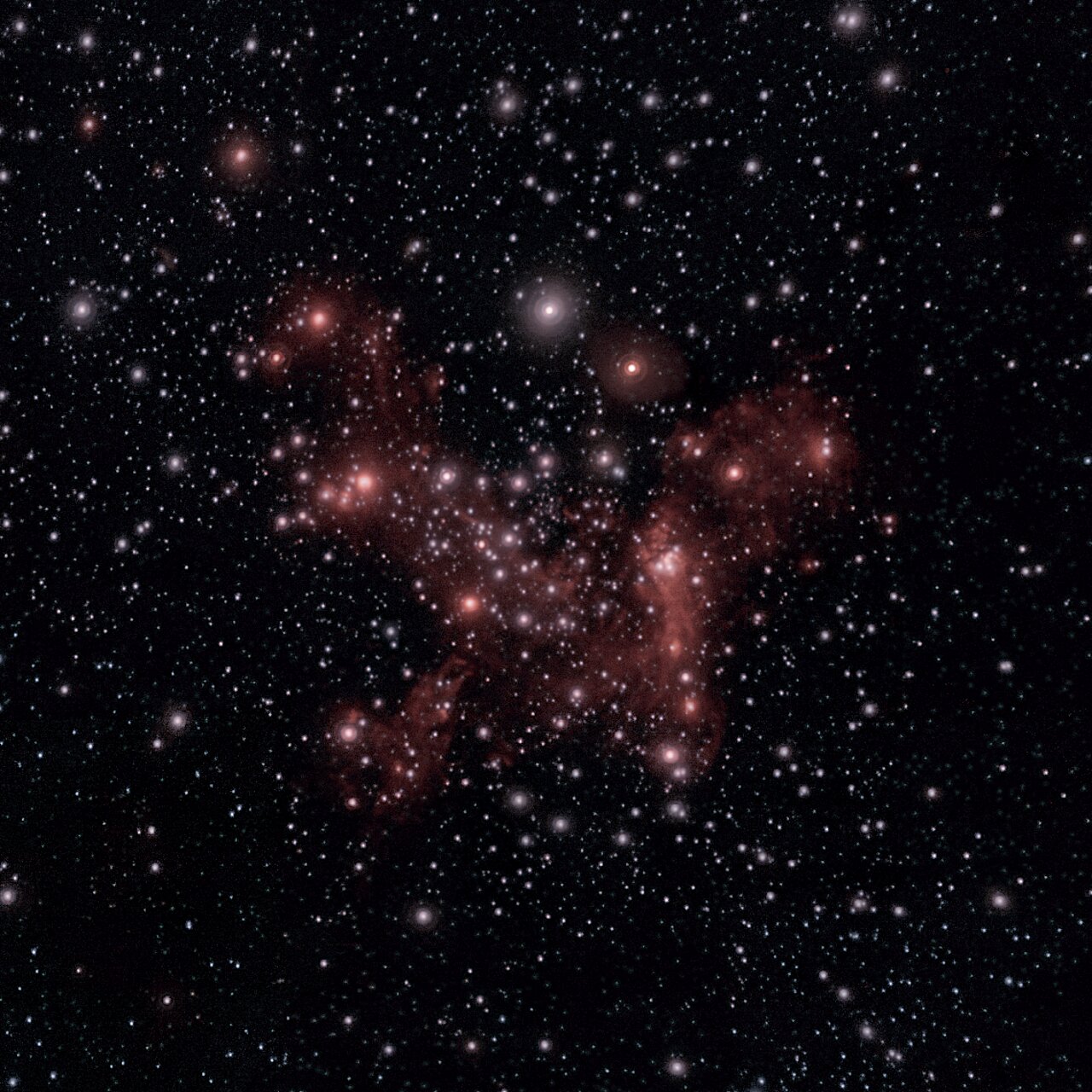
Using ESO's Very Large Telescope and its ERIS instrument, astronomers at the Max Planck Institute for Extraterrestrial Physics measured the 3D orbits of gas clouds around Sagittarius A*, the supermassive black hole at the centre of the Milky Way about 27,000 light-years away. A third cloud, G2t, was found alongside the known clouds G1 and G2. Their orbits are nearly identical, which makes it unlikely that each cloud hides its own star. The team instead suggests all three came from IRS16SW, a pair of massive stars that shed large amounts of gas as they circle the black hole. The slightly different orbits come from the gas being ejected at different points.
The finding settles a debate about what these clouds are and shows that the galactic centre is a dynamic place where stars and gas constantly interact. It also shows how precise 3D measurements can reveal the history of objects too distant to visit.
Sagittarius A* has a mass of about four million times that of the Sun.
background
Sagittarius A*, abbreviated as Sgr A* ( SADGE-AY-star), is the supermassive black hole at the Galactic Center of the Milky Way. Viewed from Earth, it is located near the border of the constellations Sagittarius and Scorpius, about 5.6° south of the ecliptic, visually close to the Butterfly Cluster (M6) and Lambda Scorpii. Sagittarius A* is a bright and very compact astronomical radio source.
In May 2022, astronomers released the first image of the accretion disk around the event horizon of Sagittarius A*, using the Event Horizon Telescope, a world-wide network of radio observatories. This is the second confirmed image of a black hole, after Messier 87's supermassive black hole in 2019. The black hole itself is not seen; as light is incapable of escaping the immense gravitational force of a black hole, only nearby objects whose behavior is influenced by the black hole can be observed. The observed radio and infrared energy emanates from gas and dust heated to millions of degrees while falling into the black hole.
From Wikipedia: Sagittarius A* (CC BY-SA 4.0) ↗


