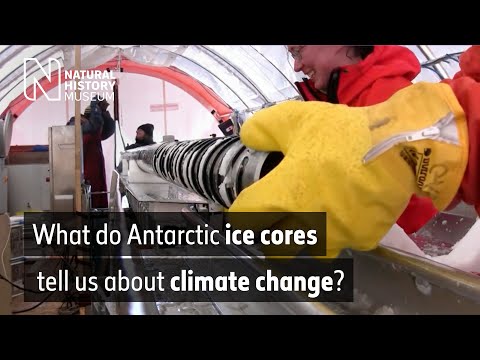
 2:36
supplementary video · Natural History Museum on YouTube ↗
nature & planetWellcome Collection1950s
Air trapped in Arctic ice is a time capsule of past atmospheres, and melting is destroying it
Bubbles of air trapped in polar ice cores let scientists sample the atmosphere of past centuries. Ice forms as snow piles up and compresses, capturing soot, pollen and tiny pockets of the air of its time. Willi Dansgaard, a Danish meteorologist, began studying this in the late 1950s, working from a fishing boat in the Arctic. In 1967 he obtained cores from Camp Century, a US Army base in Greenland, that reached back about 100,000 years. Those records showed that carbon dioxide levels were about 280 parts per million before industrial emissions, and they now exceed 420. Today, researchers face a new problem: ice in sensitive regions is melting and refreezing, which pushes out bubbles and degrades the record. Scientists such as Dorothea Moser are working out what can still be learned from that damaged ice.
Ice cores are one of the main ways scientists know how the climate has changed over hundreds of thousands of years. Losing that archive means losing evidence from exactly the regions most affected by warming.
The term global warming was popularised in 1975 by the geochemist Wallace Broecker, who drew on ice core studies.
background
An ice core is a core sample that is typically removed from an ice sheet or a high mountain glacier. Since the ice forms from the incremental buildup of annual layers of snow, lower layers are older than upper ones, and an ice core contains ice formed over a range of years. Cores are drilled with hand augers (for shallow holes) or powered drills; they can reach depths of over two miles (3.2 km), and contain ice up to 800,000 years old.
The physical properties of the ice and of material trapped in it can be used to reconstruct the climate over the age range of the core. The proportions of different oxygen and hydrogen isotopes provide information about ancient temperatures, and the air trapped in tiny bubbles can be analysed to determine the level of atmospheric gases such as carbon dioxide. Since heat flow in a large ice sheet is very slow, the borehole temperature is another indicator of temperature in the past. This data can be combined to find the climate model that best fits all the available data.
From Wikipedia: Ice core (CC BY-SA 4.0) ↗


Wellcome Collection · CC BY 4.0

