science & techMIT News
A single AI model simulates the behavior of many substances, from sliding sand to folding proteins
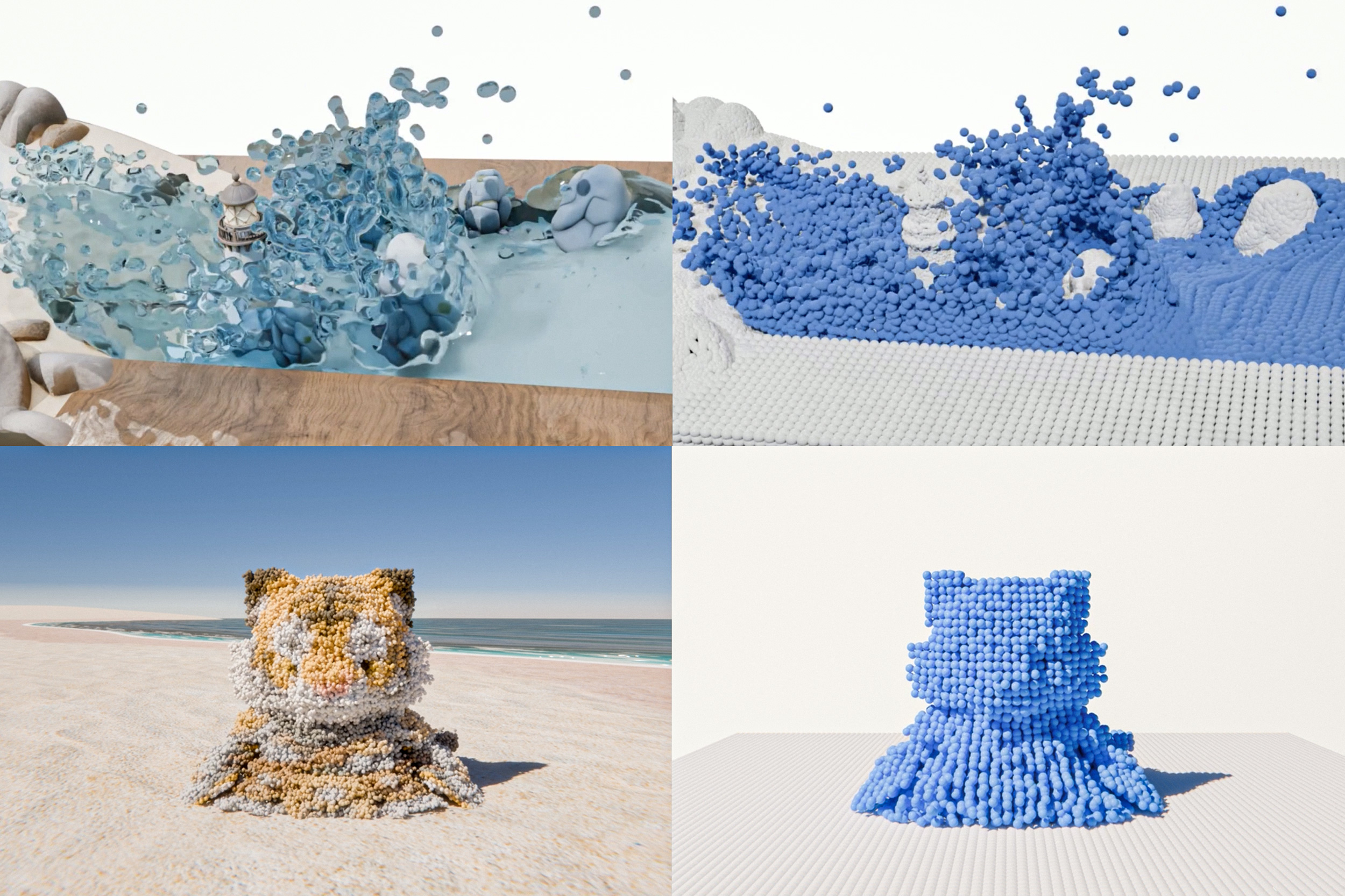
Researchers have built a single AI model that can simulate many different materials, from sand that slides and flows to the folding of proteins. The team, led by Peter Yichen Chen, uses an architecture similar to the one behind ChatGPT. Instead of predicting the next word in a sentence, the model predicts how a set of particles will move at each small step of time. Because one model handles many physical behaviours, it can stand in for specialised simulation software that has traditionally been written separately for each material. The approach shows that the transformer design used for language can also learn the rules of physics from examples.
Physics simulations are used in everything from engineering and climate modelling to drug design, and they are often slow and costly. A general-purpose model that learns physical behaviour could make these tools faster and easier to build.
background
Machine learning (ML) is a field of study in artificial intelligence concerned with the development and study of statistical algorithms that can learn from data and generalize to unseen data, and thus perform tasks without being explicitly programmed.
Statistics and mathematical optimisation methods compose the foundations of machine learning. Data mining is a related field of study, focusing on exploratory data analysis (EDA) through unsupervised learning.
From a theoretical viewpoint, probably approximately correct learning provides a mathematical and statistical framework for describing machine learning. Most traditional machine learning and deep learning algorithms can be described as empirical risk minimisation under this framework.
From Wikipedia: Machine learning (CC BY-SA 4.0) ↗


