science & techESA/Hubblebillions of years ago
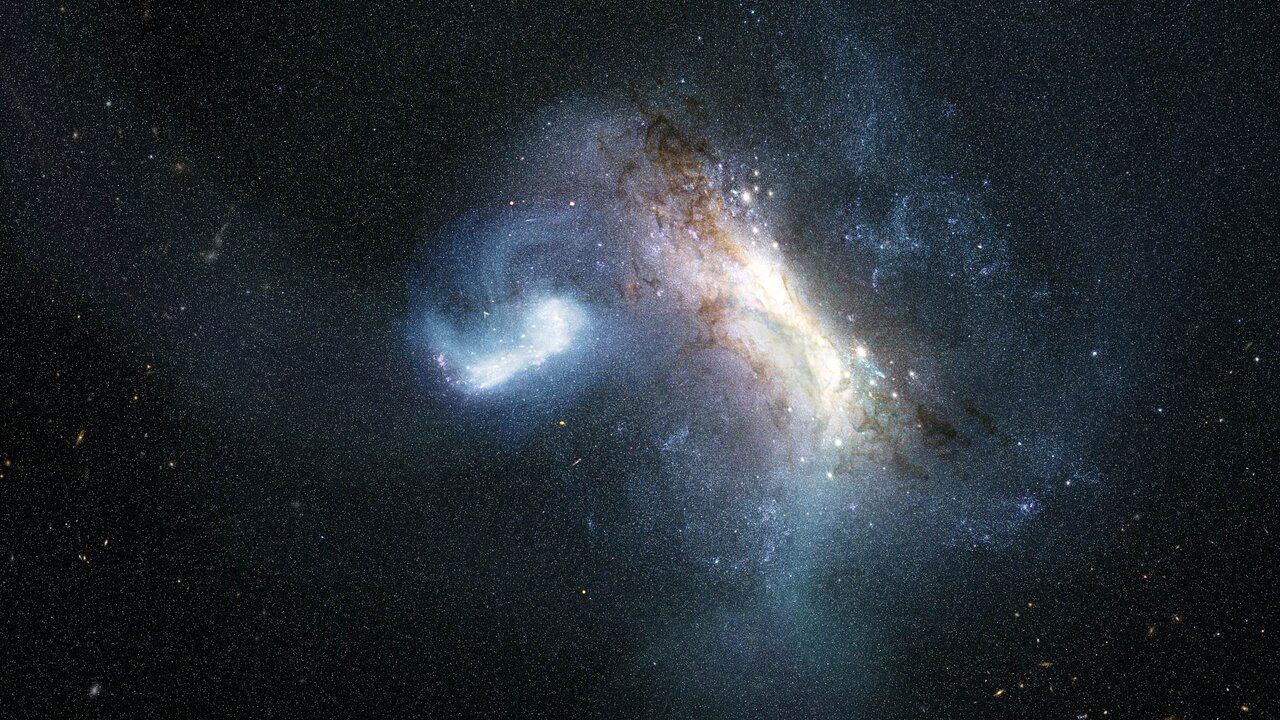
Hubble catches a dwarf galaxy merging with the young Milky Way
New data from the Hubble Space Telescope provide definitive evidence that a small dwarf galaxy merged with the Milky Way during its earliest phases. Our galaxy grew to its current size partly by absorbing smaller galaxies, and this merger has now been dated to a much earlier time. The finding extends the known history of the Milky Way by 1.8 billion years further back than previously established. It shows that the building blocks of our home galaxy were being assembled much sooner than many astronomers had thought.
Understanding how the Milky Way was built helps explain where its stars, gas and dark matter came from. Pushing this history back by nearly two billion years changes the timeline of our galaxy's formation.
background
The Milky Way or Milky Way Galaxy, or simply the Galaxy, is the galaxy that includes the Solar System, with the name describing the galaxy's appearance from Earth: a hazy band of light seen in the night sky formed by stars in other arms of the galaxy, which are so far away that they cannot be individually distinguished by the naked eye.
Galileo Galilei first resolved the band of light into individual stars with his telescope in 1610. Until the early 1920s, most astronomers thought that the Milky Way contained all the stars in the universe, but following the 1920 Great Debate between the astronomers Harlow Shapley and Heber Doust Curtis, observations by Edwin Hubble in 1923 showed that the Milky Way was just one of many galaxies.
From Wikipedia: Milky Way (CC BY-SA 4.0) ↗


