science & techESA/Hubble
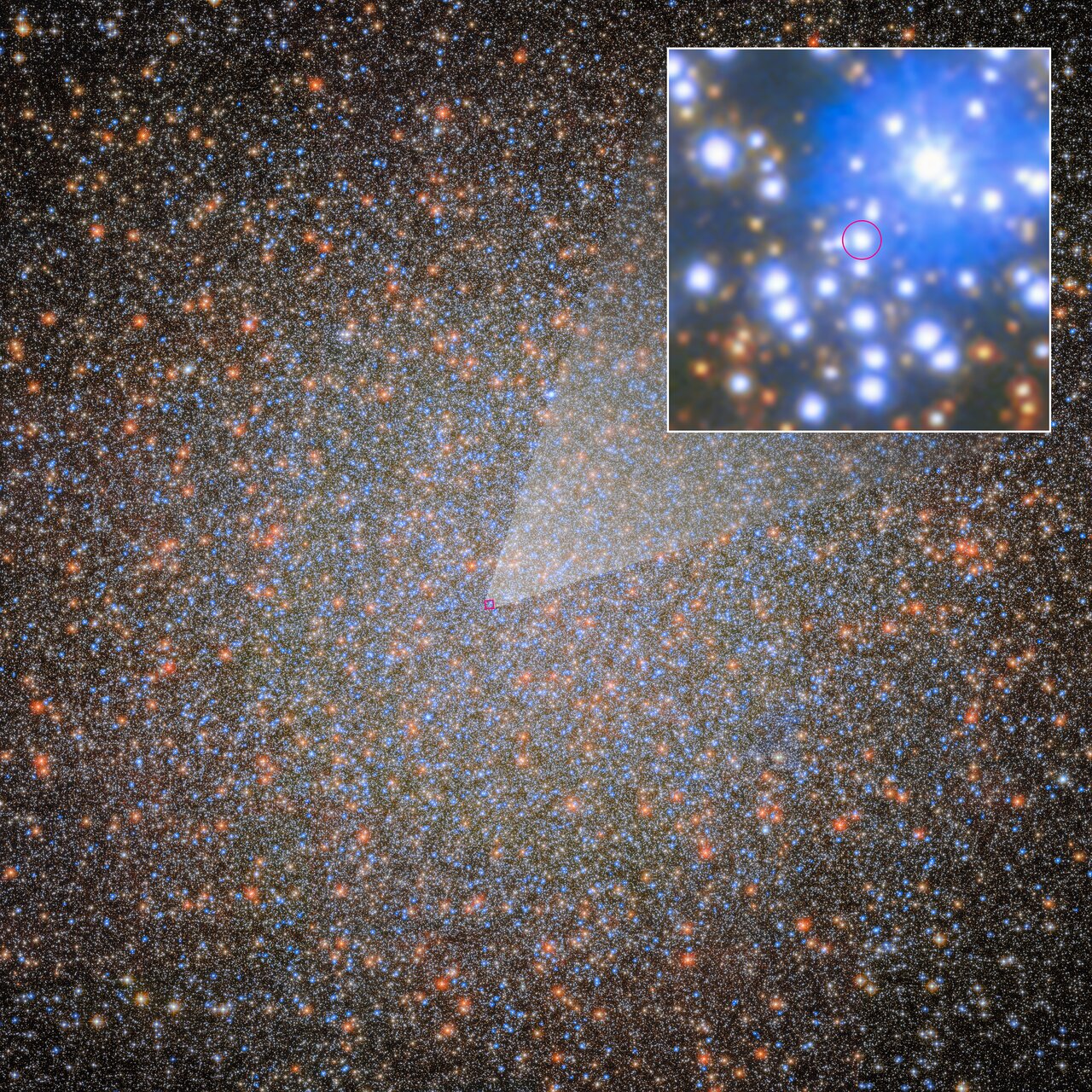
Hubble finds the first black hole hiding in the Omega Centauri star cluster
Omega Centauri is a massive globular cluster of stars, and astronomers expected it to contain many black holes left by exploded stars. Evidence for them had been scarce for years. Using archival data from the Hubble Space Telescope along with observations from the James Webb Space Telescope, a team has now identified its first stellar-mass black hole. The discovery helps confirm that the cluster likely holds a larger hidden population of such objects.
The find strengthens the idea that dense star clusters hide many black holes that are hard to detect. It also shows how combining archival and new observations from different telescopes can answer long-standing questions.
background
Omega Centauri (ω Cen, NGC 5139, or Caldwell 80) is a globular cluster in the constellation of Centaurus that was first identified as a non-stellar object by Edmond Halley in 1677. Located at a distance of 17,090 light-years (5,240 parsecs), it is the largest known globular cluster in the Milky Way at a diameter of roughly 150 light-years. It is estimated to contain approximately 10 million stars, with a total mass of 4 million solar masses, making it the most massive known globular cluster in the Milky Way.
Omega Centauri is very different from most other galactic globular clusters to the extent that it is thought to have originated as the core remnant of a disrupted dwarf galaxy. There is evidence of an intermediate-mass black hole in the dense core of this cluster, although this is disputed.
From Wikipedia: Omega Centauri (CC BY-SA 4.0) ↗


