science & techESO
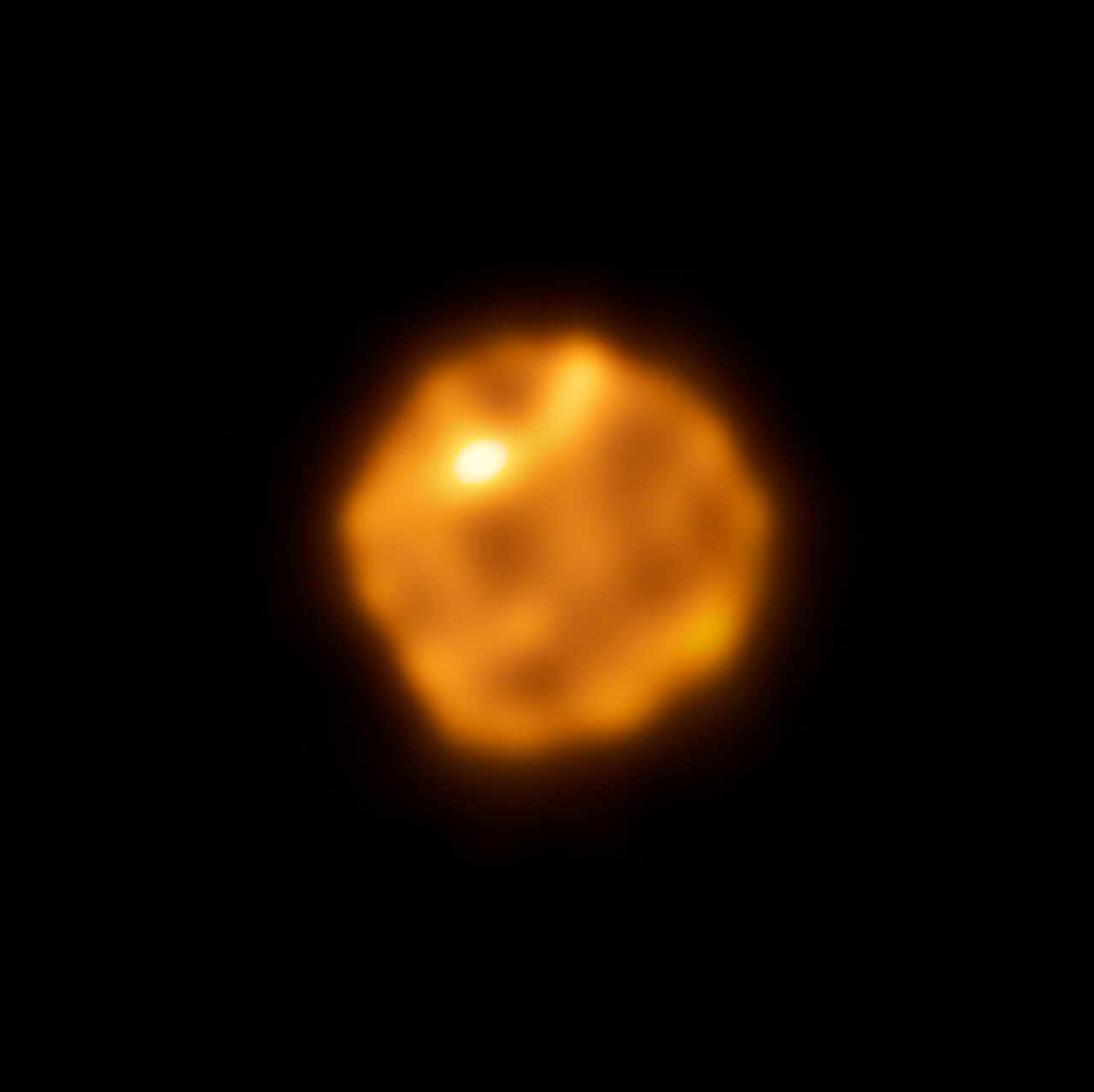
ALMA has produced one of the most detailed views yet of Betelgeuse's lumpy surface
ALMA, the radio telescope array in Chile, has produced one of the most detailed images so far of the surface of Betelgeuse. The star is a red supergiant about 600 light-years away in Orion, and it is almost 800 times the size of the Sun. Unlike the smooth Sun, Betelgeuse has a highly uneven, bubbling surface with peaks and troughs. The image shows giant convection cells, large rising and sinking patches of hot gas, that churn across the star. Seeing that structure directly helps astronomers understand how such a huge star loses mass and behaves before its eventual death.
Betelgeuse is one of the best-known stars in the sky, and its surface behaviour matters for understanding how red supergiants shed material. The image turns a bright point of light into a visible, changing object.
If Betelgeuse were placed at the centre of our Solar System, its outer edge would reach beyond the orbit of Mars.
background
Betelgeuse is a red supergiant star in the equatorial constellation of Orion. It is usually the tenth-brightest star in the night sky and, after Rigel, the second brightest in its constellation. It is a distinctly reddish, semiregular variable star whose apparent magnitude, varying between +0.0 and +1.6, with a main period near 400 days, has the widest range displayed by any first-magnitude star. Betelgeuse is the brightest star in the night sky at near-infrared wavelengths. Its Bayer designation is α Orionis, Latinised to Alpha Orionis and abbreviated Alpha Ori or α Ori.
From Wikipedia: Betelgeuse (CC BY-SA 4.0) ↗


