science & techESA/Hubble2025 · Solar System
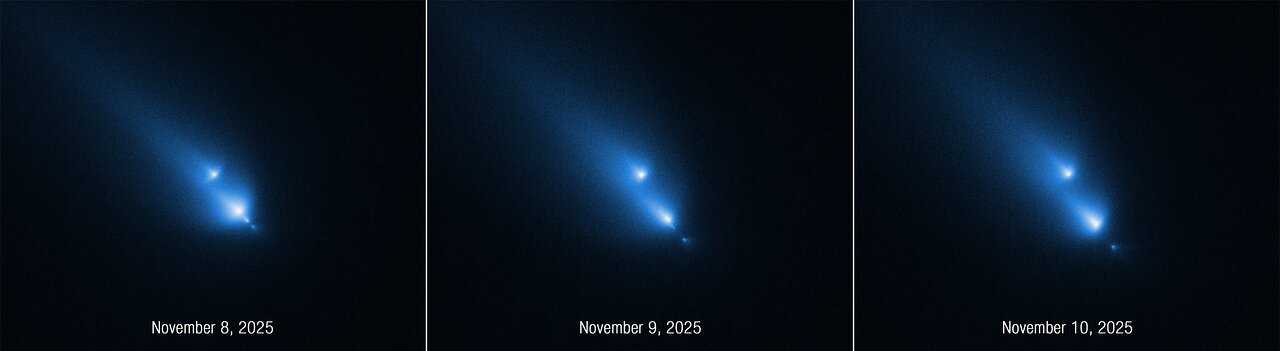
Hubble caught a comet breaking into pieces right after passing the Sun
Comet C/2025 K1 (ATLAS), which had just passed its closest approach to the Sun and was heading out of the Solar System, was caught by the Hubble Space Telescope breaking into at least four pieces in November 2025. It had been intact only days before. Comets are loose mixtures of ice and dust, and passing near the Sun heats them, causing gas to jet away and the nucleus to weaken. Thermal stress and the pressure of escaping gas can then tear the body apart. Catching a fragmentation in the act is rare and shows what comets are made of.
Comet breakups reveal their inner structure, which holds material left over from the formation of the Solar System about 4.6 billion years ago.
Comet Shoemaker-Levy 9 was torn apart by Jupiter's gravity before hitting the planet in 1994.
background
C/2025 K1 (ATLAS) is a non-periodic comet first seen in May 2025. It is one of many comets discovered by the Asteroid Terrestrial-impact Last Alert System (ATLAS). The comet is dynamically new, having come directly from the Oort cloud. With perihelion only 0.33 AU (49 million km; 31 million mi) from the Sun, the comet was not expected to survive perihelion passage, but it did and was recovered on 18 October 2025. The comet has broken into multiple fragments and fragments A+B+D should be ejected from the Solar System. Fragment-C may remain bound to the Solar System.
From Wikipedia: C/2025 K1 (ATLAS) (CC BY-SA 4.0) ↗


