science & techESA/Webb
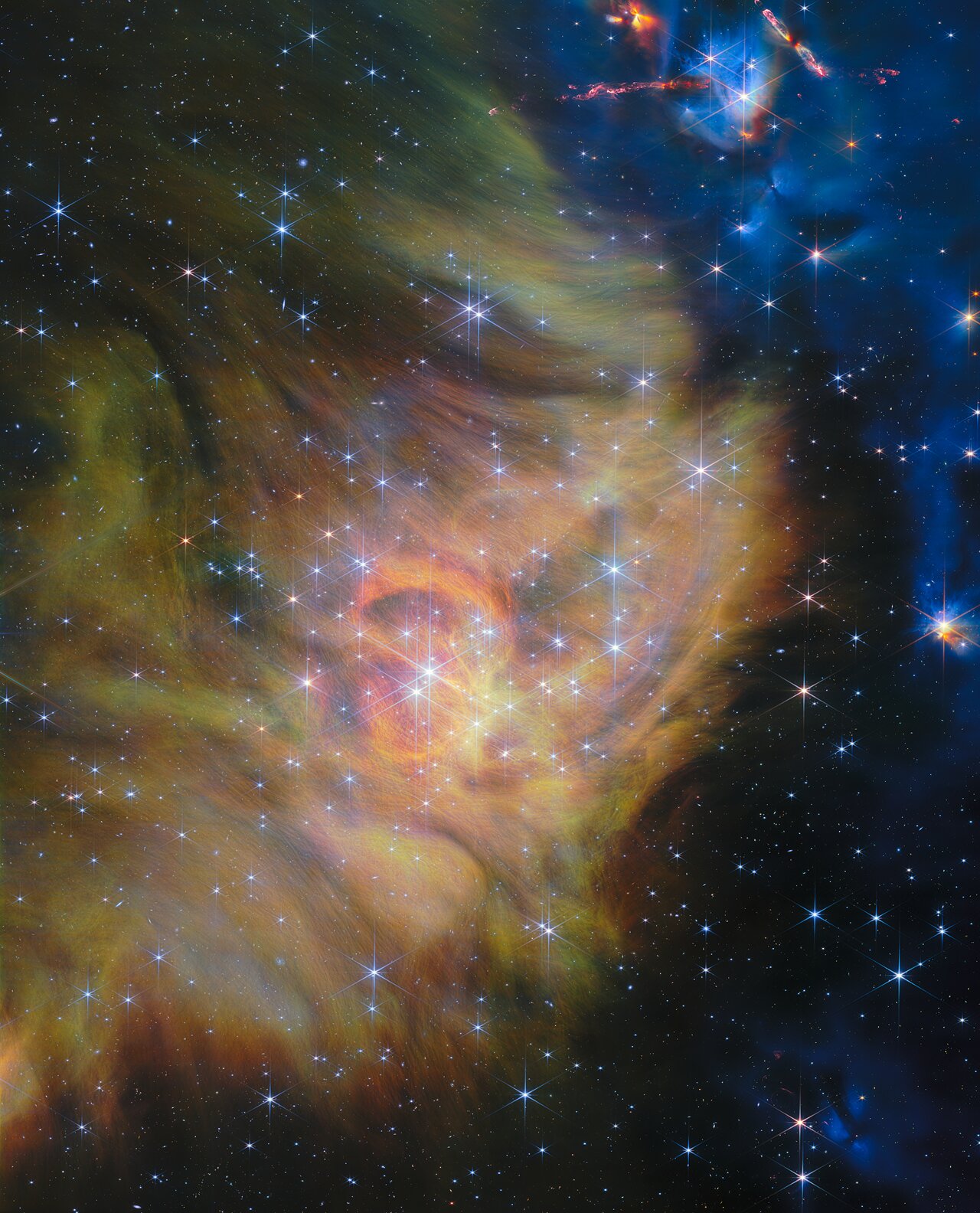
Webb's new image of IC 348 shows brown dwarfs, objects too small to be stars
The James Webb Space Telescope has imaged IC 348, a star-forming region about 1,000 light-years away. It is one of the largest Webb images released to the public so far. Using the sensitivity of its NIRCam instrument, the telescope picked out a population of brown dwarfs. These objects are smaller than the smallest stars, and the image tracks down the faintest of them. The view reveals how the region is populated across a wide range of masses.
Brown dwarfs are hard to find because they are faint, so the image helps astronomers count the smallest objects that form alongside stars. That gives a more complete picture of how stellar nurseries produce objects of all sizes.
Brown dwarfs are too small to sustain hydrogen fusion in their cores as stars do.
background
IC 348 is a star-forming region in the constellation Perseus, just south of the bright star Omicron Persei. It is located about 1,000 light years from the Sun. Together with NGC 1333 it is part of the Perseus molecular cloud. It consists of nebulosity and an associated 2-million-year-old cluster of roughly 400 stars within an angular diameter of 20″. A later work found an older age of about 5 million years. The most massive stars in the cluster are the binary star system HD 281159 (BD+31°643), which has a combined spectral class of B5, and is surrounded by an accretion disk. This binary is surrounded by an incomplete spherical shell open to the northwest, 50,000 AU in diameter, seen in infrared images from Spitzer and JWST.
From Wikipedia: IC 348 (CC BY-SA 4.0) ↗


