science & techESA/Webb
Webb has confirmed the most distant fast radio burst, which came from a galaxy 3 billion years after the Big Bang
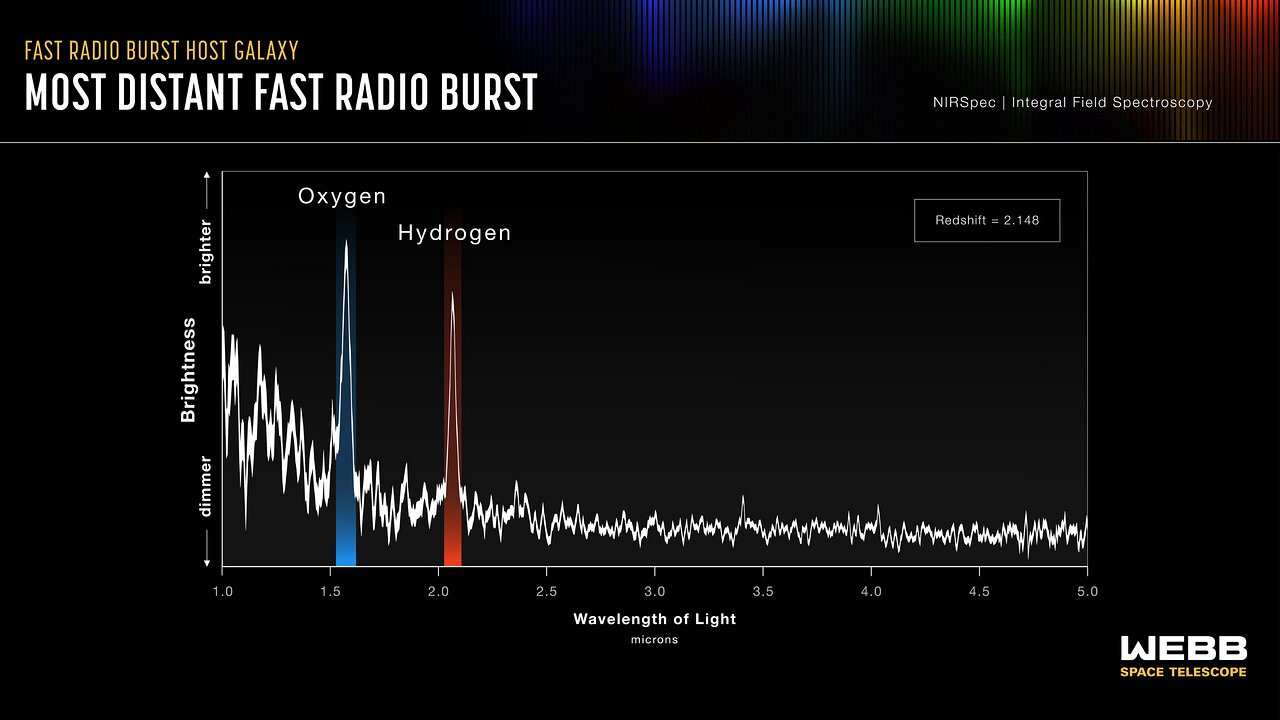
Astronomers used the James Webb Space Telescope to study the host galaxy of the most distant fast radio burst known. Fast radio bursts are brief, intense flashes of radio waves from far outside our galaxy. By detecting light from oxygen and nitrogen in the galaxy, the team measured its redshift, which tells how much its light has been stretched by the expansion of the universe. That measurement places the burst just 3 billion years after the Big Bang. The result connects a mysterious signal to a specific, very early galaxy and gives astronomers a fixed distance for it.
Knowing where a fast radio burst comes from and how far away it is lets astronomers use these flashes as probes of the material between galaxies. It also shows Webb can study galaxies that are very far and very faint.
Fast radio bursts were first discovered in 2007 and were long a mystery.
background
In radio astronomy, a fast radio burst (FRB) is a transient radio wave caused by a high-energy astrophysical process that is not yet understood. The duration of an FRB is typically around a few milliseconds, although ultra-fast radio bursts may only last 15 microseconds or less. Astronomers estimate the average FRB releases as much energy in a millisecond as the Sun puts out in three days. While extremely energetic at their source, the strength of the signal reaching Earth has been described as 1,000 times less than from a mobile phone on the Moon.
The first FRB was discovered by Duncan Lorimer and his student David Narkevic in 2007 when they were looking through archival pulsar survey data, and it is therefore commonly referred to as the Lorimer burst. Many FRBs have since been recorded, including several that have been detected repeating in seemingly irregular ways. Only one FRB has been detected to repeat in a regular way: FRB 180916 seems to pulse every 16.35 days.
From Wikipedia: Fast radio burst (CC BY-SA 4.0) ↗


