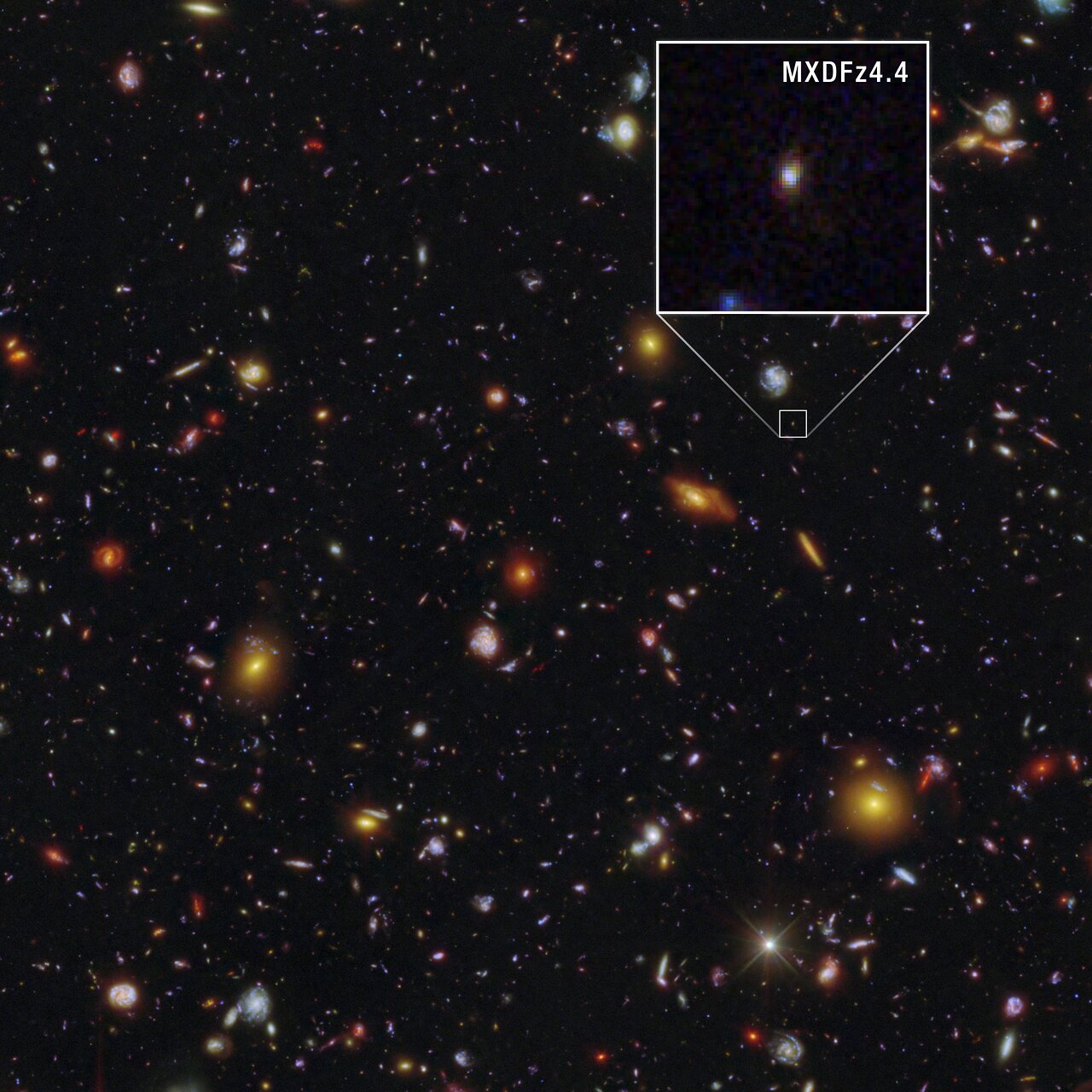
science & tech·ESA/Hubble1.4 billion years after the Big Bang
A galaxy from 1.4 billion years after the Big Bang cleared its own fog with young stars
the gist
Astronomers using the Hubble Space Telescope found ultraviolet light from a galaxy that existed just 1.4 billion years after the Big Bang. The galaxy contains tightly clustered young stars whose ionising light is strong enough to transform the dense neutral gas inside and around it. That clearing effect makes the galaxy visible to telescopes, which would otherwise be blocked by the opaque gas. The result suggests that early galaxies may have shaped their surroundings much as later ones do, and that the young universe was more transparent in places than expected. The observation shows how the earliest stars helped reionise the cosmos.
so what
The early universe was filled with neutral hydrogen, and figuring out how it became transparent is a central question in cosmology. This galaxy offers a direct view of the process at work.
In 1909 D. W. Griffith made a 14-minute film about a speculator who corners the wheat market and doubles the price of bread. A farmer sows his field while a 'Wheat King' gambles in the Chicago wheat pit; bakers raise the loaf from five cents to ten and the poor line up for bread. Griffith cut back and forth between the farm, the feast and the breadline, a technique called parallel editing, so audiences saw both ends of the economy at once. The film drew on Frank Norris's stories and on a real scheme: months earlier Chicago financier James Patten had cornered wheat, sent bread prices up and made about $5 million, roughly $185 million today.
how it works
To corner a market, a trader buys up most of the available supply and the futures contracts that promise more. Anyone who has to deliver the commodity must then buy from the cornerer at whatever price is demanded. The trader profits until the stock is released or the scheme collapses.
so what
A century on, it still shows how markets can be rigged by someone who controls supply, and how the people at either end, farmers and eaters, pay for it. It also helped establish editing as a way to argue a point, not just tell a story.
the bigger pattern
Corners have recurred whenever supply could be locked up, from the Hunt brothers' attempt on silver in 1979 to 1980 to the 'Black Friday' gold panic of 1869. Many such schemes end by collapsing, and the response is often new rules on speculation.
fun fact
In the film the Wheat King dies by falling into a grain elevator and being buried in the wheat he hoarded, an ending borrowed from Norris's novel The Octopus.
more on this
background
A Corner in Wheat is a 1909 American short silent film which tells of a greedy tycoon who tries to corner the market in wheat, destroying the lives of the people who can no longer afford to buy bread. It was directed by D. W. Griffith and adapted by Griffith and Frank E. Woods from a novel and a short story by Frank Norris, titled The Pit and "A Deal in Wheat". Griffith may have had a real-life inspiration: six months earlier, James A. Patten had actually cornered the market in wheat, and in some cities, the price of bread doubled from five cents to ten, just as in the movie.
In 1994, A Corner in Wheat was selected for preservation in the United States National Film Registry by the Library of Congress as being "culturally, historically, or aesthetically significant".
Usman Khawaja refuses to answer Sandpapergate question about Pat Cummins | 7.30
from ABC News In-depth
One of the darkest days in Australia's sporting history has been dragged back into the spotlight.
A new autobiography by former Test cricketer Usman Khawaja has made explosive revelations about the Australian Test team's 2018 ball-tampering saga in South Africa.
7.30 host Sarah Ferguson speaks to Usman Khawaja.
7.30 is the ABC's flagship current affairs program, delivering original journalism, exclusive investigations, in-depth analysis and interviews on the major issues affecting Australia and the world.
With on-the-ground reporting from ABC journalists across every state and territory and around the world, 7.30 has the latest on politics, policy, the economy, cost of living, housing, health, climate and energy, national security and global affairs.
Note: In most cases, our captions are auto-generated.