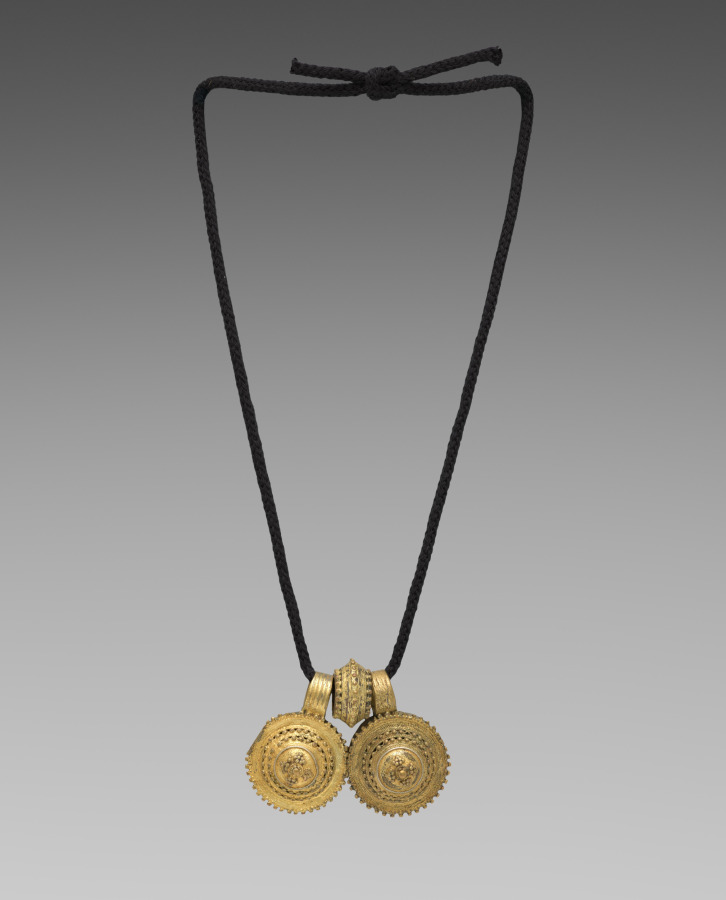
world cultures & travelCleveland Museum of Artlate 1800s or early 1900s · Ethiopia
Ethiopian silversmiths made amulet boxes meant to protect the person who wore them
Ethiopian silversmiths made this necklace from numerous small box-shaped pendants, called tälsäm, which were worn to ward off the evil eye and other dangers. The practice draws on Islamic amulet traditions: a box is considered effective whether it is empty or holds prayers or magical texts. Ornate filigree jewellery of this kind was made for royals and nobility by specialist silversmiths who trained through long apprenticeships, and its fine granulation work is associated with Harar and the Orthodox city of Aksum. Gold and silver jewellery has been made in Ethiopia for at least 2000 years. This example is gold-washed silver, dating from the late 1800s or early 1900s.
The necklace shows how Ethiopian metalwork and Islamic protective practices blended over centuries in the Horn of Africa. It also shows that jewellery could be both ornament and personal protection.
background
An amulet is a spiritual object believed to confer protection or grace upon its possessor. The word amulet comes from the Latin word amuletum, which Pliny's Natural History describes as "an object that protects a person from trouble". Anything can function as an amulet; items commonly so used include statues, coins, drawings, plant parts, animal parts, and written words. The word phylactery is sometimes used as a general synonym likewise referring to any unspecified amulet, but also has a specific definition within Judaism. Certain amulets may also qualify more specifically as a devotional article, good luck charm, or even both in rare circumstances, but those categories represent only subsets of amulets (the proper, inclusive term).
From Wikipedia: Amulet (CC BY-SA 4.0) ↗ · text CC BY-SA 4.0


Cleveland Museum of Art · CC0
Image: Cleveland Museum of Art, 2025.154 · CC0


