world cultures & travelCleveland Museum of Art1800s · Kumasi, Asante Kingdom, Ghana
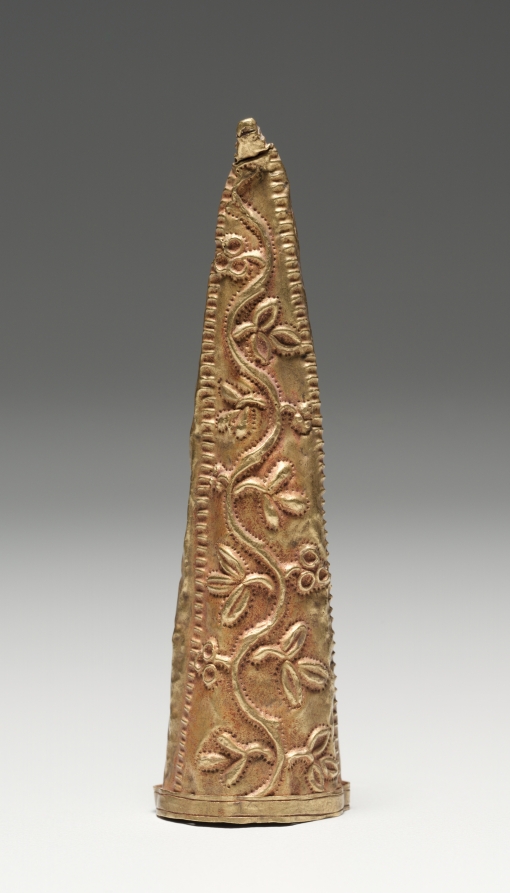
Asante goldsmiths decorated a king's knife tip with gold repoussé
In the Asante Kingdom of present-day Ghana, a king's ceremonial knife had a cast iron blade wrapped in gold sheaths. Only members of the goldsmiths' guild could make gold ornaments for the royal household, and gold was valued because it embodied life force, called kra, and was seen as the sun's earthly counterpart. This tip was decorated with repoussé: the goldsmith pushed floral, leaf and geometric designs out from the back of a soft gold sheet, then punched small dots to outline some motifs. Gold objects were often melted down and remade in new fashions, so surviving pieces show only part of the original output.
The tip shows how gold in Akan states carried spiritual and political meaning, and how strictly royal craft was controlled. It is a clear window into court art of the 1800s.
background
The Asante Empire (Asante Twi: Asanteman), also known as the Ashanti Empire, was an Akan state that lasted from 1701 to 1902, in what is now modern-day Ghana. It expanded from the Ashanti Region to include most of Ghana and also parts of Ivory Coast and Togo. Due to the empire's military prowess, wealth, architecture, sophisticated hierarchy, trade networks and culture, the Asante Empire has been extensively studied and has more historic records written by European, primarily British, authors than any other indigenous culture of sub-Saharan Africa.
From Wikipedia: Asante Empire (CC BY-SA 4.0) ↗ · text CC BY-SA 4.0see


key facts
- Capital
- Kumasi
- Population
- 3.0 million
- Area
- 259,000 km²
- Founded
- 1670
Facts: Wikidata (CC0)
Cleveland Museum of Art · CC0
Image: Cleveland Museum of Art, 1935.312 · CC0


