 2:20
supplementary video · Amit Sengupta on YouTube ↗
world cultures & travelWikivoyage1891–1916 · Russia
The Trans-Siberian is a rail network linking Moscow to the Pacific, not a single train
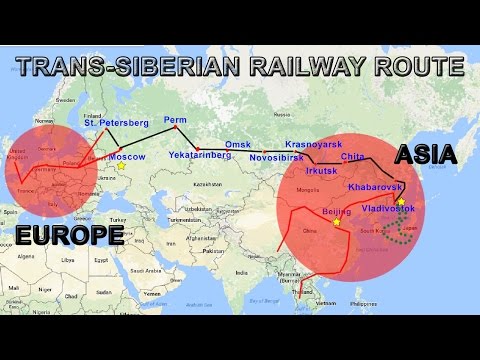
The Trans-Siberian is not one train but a network of rail routes crossing Siberia from Moscow. The main line runs about 9,300 km through Perm, Yekaterinburg, Omsk, Novosibirsk, Irkutsk and Khabarovsk to Vladivostok on the Pacific coast, and it was built between 1891 and 1916. Two branches leave the main line: the Trans-Mongolian heads south into Mongolia and China, and the Trans-Manchurian crosses Manchuria. Several named passenger trains run along these routes, and a full end-to-end journey takes about a week. The line was designed to bind Siberia's resources and population to European Russia.
Russia uses a track gauge of 1,520 mm, wider than the 1,435 mm standard used across much of Europe, so its trains and tracks differ from Western systems. Because the whole network shares this gauge, a single set of carriages can run the main route without changing equipment.
The railway opened up Siberia for settlement, mining and trade, and it still carries a large share of Russian freight and passenger travel. Its branches link Russia with Mongolia and China, making it one of the world's most important overland transport corridors.
background
The Trans-Siberian Railway, historically known as the Great Siberian Route and often shortened to Transsib, is a large railway system that connects European Russia to the Russian Far East. Spanning a length of over 9,289 kilometers (5,772 miles), it is the longest railway line in the world. It runs from the city of Moscow in the west to the city of Vladivostok in the east.
From Wikipedia: Trans-Siberian Railway (CC BY-SA 4.0) ↗ · text CC BY-SA 4.0


Adapted from Wikivoyage, the free travel guide · CC BY-SA 4.0


