science & techNASA
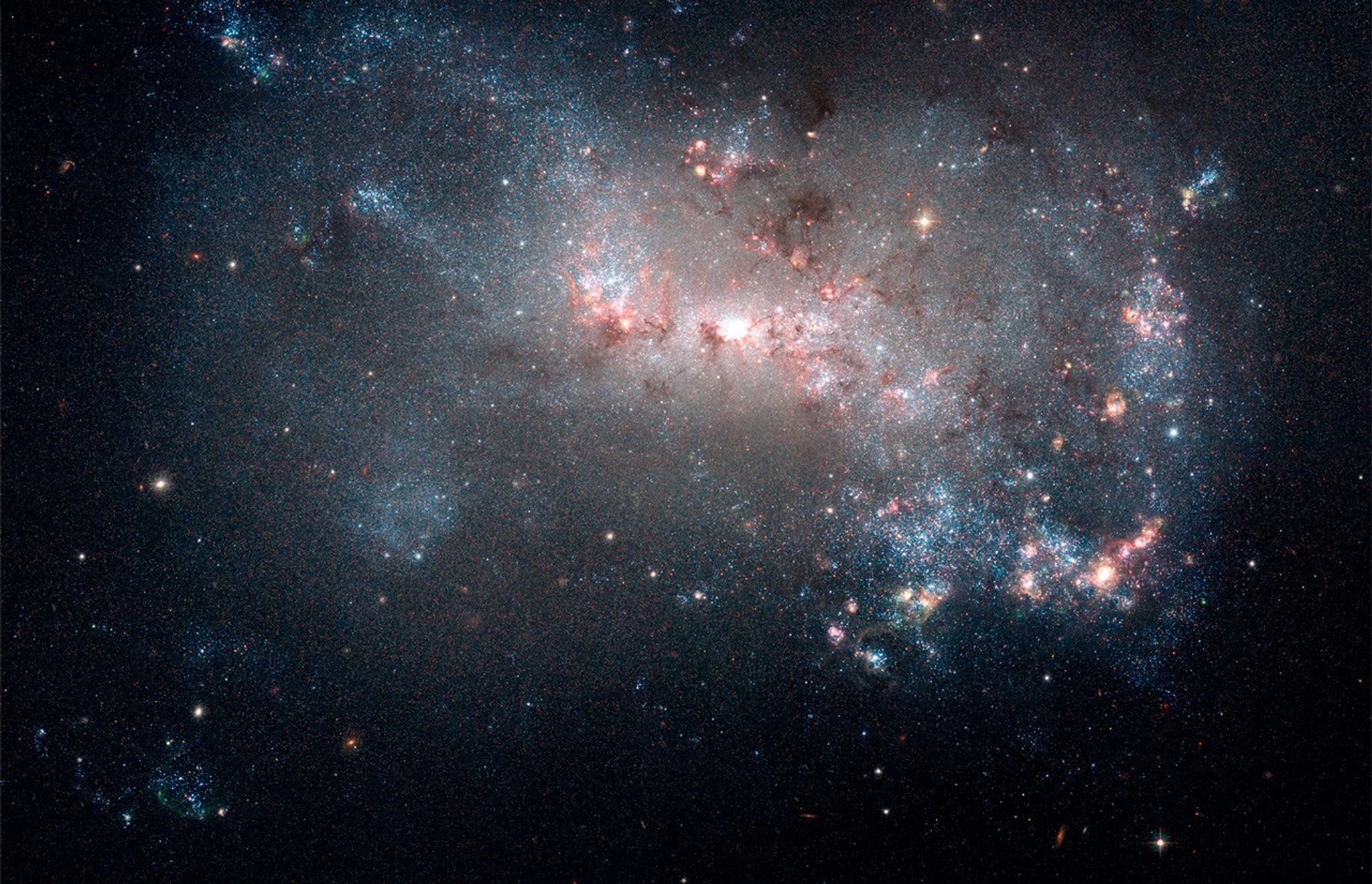
APOD: 2026 November 11 – NGC 4449: Small Galaxy, Big Impact
Size isn't everything for galaxies. The Milky Way is about 100,000 light years across and holds hundreds of billions of stars, while dwarf galaxies are about a tenth as wide and hold only a few billion, yet they are the most common type of galaxy in the universe. NGC 4449, imaged by the Hubble Space Telescope, is one of them. It and similar dwarf galaxies are missing more oxygen than models predict, which suggests that their stellar winds and supernova explosions are unusually good at blowing oxygen and other heavy elements out into space.
Heavy elements are the raw material of planets and life, and stars make them. If small galaxies fling them out so effectively, dwarfs may play a large role in spreading these elements through the universe.
NGC 4449 is a bright dwarf galaxy in the constellation Canes Venatici that is known for intense star formation.
background
NGC 4449, also known as Caldwell 21, is an irregular Magellanic type galaxy in the constellation Canes Venatici. It was discovered by German-British astronomer William Herschel on 27 April 1788. This galaxy is located about 13 million light-years away, where it is part of the M94 Group or Canes Venatici I Group that is relatively close to the Local Group hosting our Milky Way galaxy.
From Wikipedia: NGC 4449 (CC BY-SA 4.0) ↗ · text CC BY-SA 4.0


